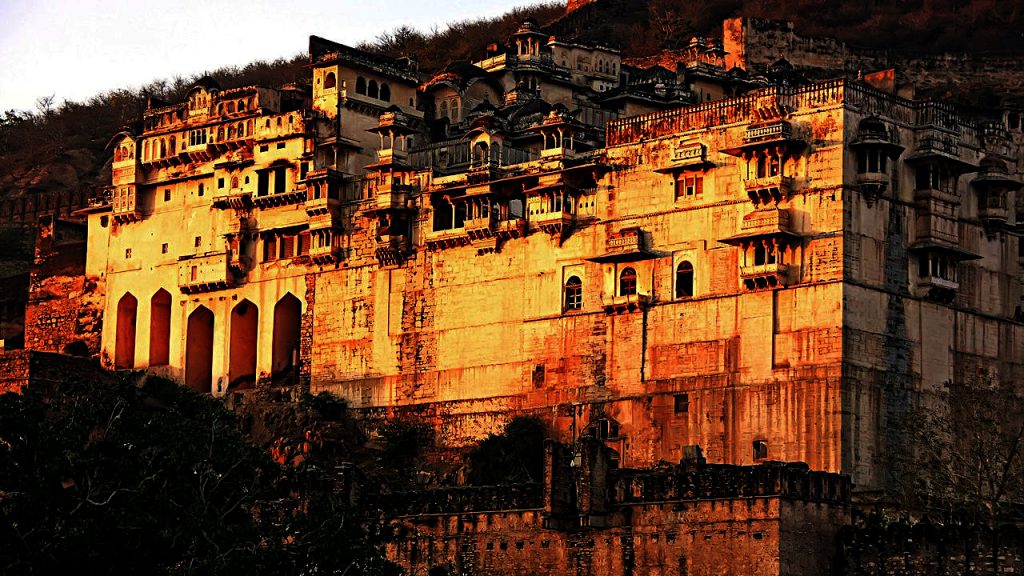
Welcome to Bundi
Nestled amidst the Aravalli hills, Bundi is a picturesque town in Rajasthan that once served as the stronghold of the Hada Rajputs. Established in 1241 by Rao Deva Singh after conquering the region from the Meena tribe, Bundi flourished as a princely state, showcasing a rich tapestry of Rajput architecture and culture. Visitors can explore the imposing Taragarh Fort, admire the exquisite murals of Bundi Palace, and marvel at the intricate design of Raniji ki Baori, a 46-meter-deep stepwell built in 1699. The town’s serene lakes, such as Nawal Sagar with its half-submerged Varuna temple, and the twin stepwells of Nagar Sagar, further add to its charm. With its narrow lanes, blue-hued houses, and timeless ambiance, Bundi offers a unique glimpse into Rajasthan’s regal past
Bundi is nestled in the cleft of the Araavali hills and has a special medieval flavor quite untouched by time. Prince Jait Singh of Bundi captured Kota in 1264 and Kota became a part of Bundi as the Jaghir (land grant) of the eldest prince of Bundi. Kota became a separate state in 1624. The state of Jhalawar was formed in 1838 out of Kota territory.
Hada Rajputs are a major branch of the Chauhan Agnikula (fire dynasty) Rajputs. They had settled in the hilly terrain of Mewar, at Bambaoda, near Bijolian in the 12C. Bundi was conquered in 1241 by Rao Deva Singh from the Meena tribe. This was the first step in the establishment of Hadaoti, when the Hadas moved down from the ‘Pathar’ around Bambaoda. Bundi takes its name from the Bando Naal or the narrow passage, between the rugged hills. Bundi was loyal to the Mughals from the late 16th century, but it maintained its independent status until incorporated into the state of Rajasthan after 1947.
A captivating town with narrow lanes of Brahmin-blue houses, lakes, hills, bazaars and a temple at every turn, Bundi is dominated by a fantastical palace of faded parchment cupolas and loggias rising from the hillside above the town.Though not popular as Jaipur or Udaipur neitherts streets are choked with noisy, polluting vehicles or dense throngs of people. it retains the magical atmosphere of centuries past and is the best placeto be for the Teej festival.
Bundi Sightseeing Places
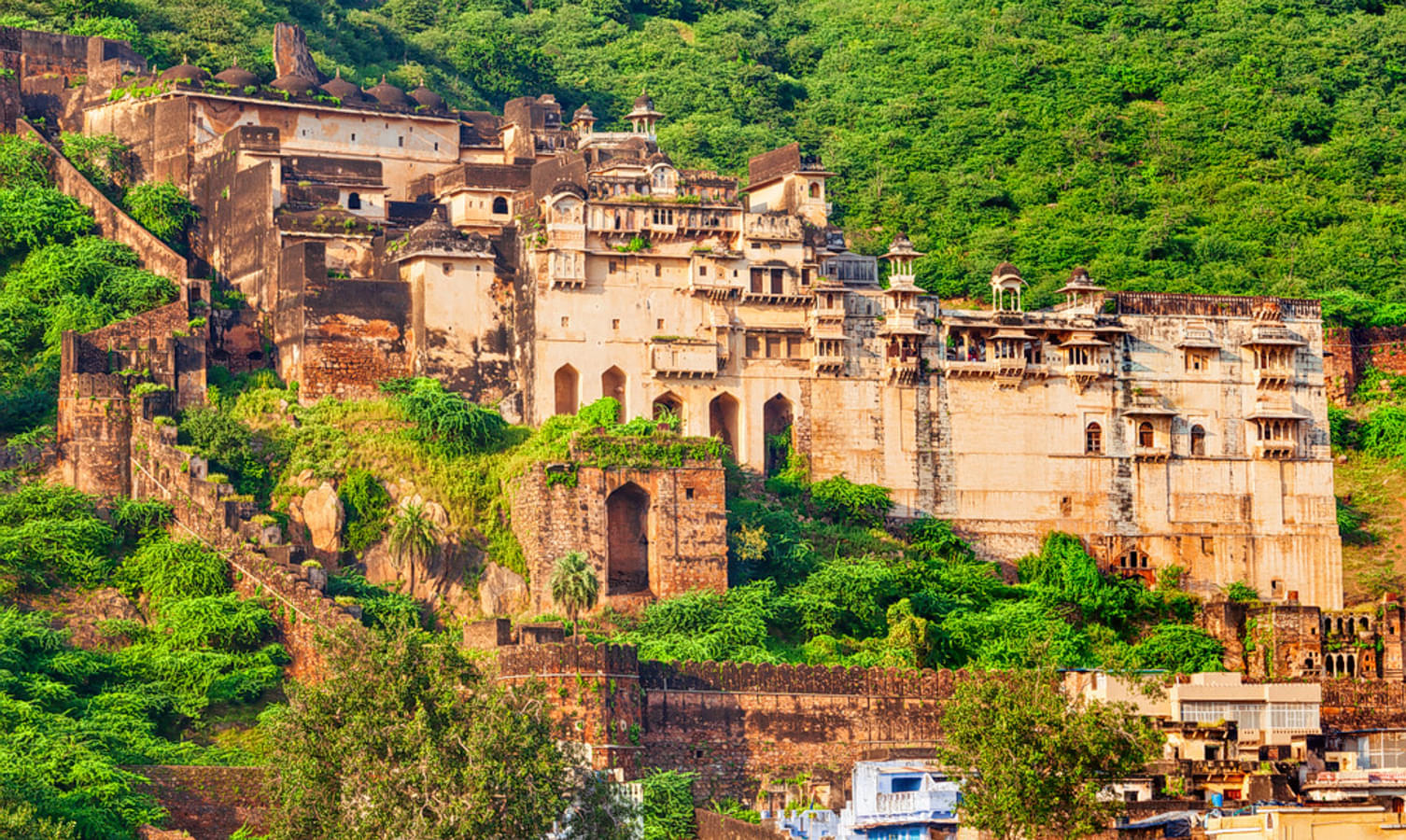
TARARGH FORT – 14th CENTURY:One of the most impressive fort and impregnable forts in Rajasthan. It has four enormous water reservoirs which were built to cater to the water requirements of the fort. The panoramic view of Bundi and surrounding hills is magnificent, an ideal place to sit quietly and watch the sunset. Taragarh means the ‘Star Fort’ is the most impressive of the city’s structures. It was constructed in AD 1354 upon a steep hillside. The largest of its battlements is the 16th century bastion known as the Bhim Burj or ‘Thunder from the Womb’. The fort has three tanks which never dries. These tanks are right on top of the fort which sits on top of one of the hills surrounding the city. The technique is long since lost but the tanks survive as a testament to the advanced methods of construction and engineering in medieval India.
Bundi Palace– situated on the hillside adjacent to the Taragarh Fort and is notable for its lavish traditional murals and frescoes. The Chitrashala (picture gallery) of the palace is open to the general public.
The largest of Bundi’s baoris or stepwells is the intricately-carved Raniji ki Baori. Some 46 m deep, it was built in 1699 by Rani Nathavatji. The steps built into the sides of the water-well-made water accessible even when at a very low level. The baori is one of the largest examples of its kind in Rajasthan.
KesharbaghThe final resting place of Bundi’s kings and queens, Kesharbargh isfine example of Bundi’s impressive architecture. The cenotaphs are beautifully crafted from fine yellow sandstone and marble.
The Nawal Sagar :
It is a large square-shaped artificial lake in the centre of Bundi containing many small islets. A temple dedicated to Varuna, the vedic god of water, stands half-submerged in the middle of the lake. the lake feeds the numerous bavdis in the old city by creating an artificial water table.
The Nagar Sagar:The twin step wells are identical step wells crafted in pristine masonry on either side of the main spine of Bundi town. The kunds (pools) are currently full of waste from the ancient vegetable market in the vicinity.
The Dabhai Kund: Also known as the jail kund, is the largest of the kunds in Bundi. The spectacular carvings on the numerous steps leading down to the water level.